
Discover how internal mobility strategy drives workforce agility and leadership development ROI. Expert insights on talent redeployment for HR leaders.
Agility and resilience are in every conversation – from the board room to the classroom, professionals are in a forced transition to ready their mindset and career for change. The top factors include advancements in technology and AI, the geopolitical climate, and the evolution of what skills matter most across industries and functions.
Workforce agility specifically focuses on one’s ability to change on a dime, to pivot when needed as things happen around you. The human experience naturally needs us to be agile, so what’s different about this as it relates to career and work? Much of it has to do with a change in our relationship to career.
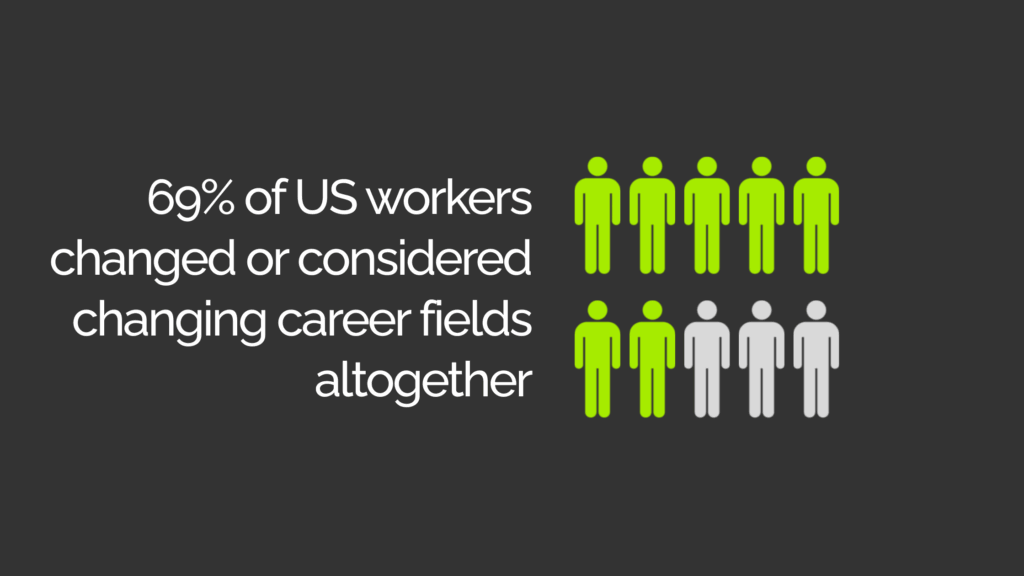
In the last few years, societally, we’ve changed the narrative from having people follow their passion to having skills and talents that are irreplaceable. Even then, we’ve seen very talented, smart, and experienced professionals lose their jobs because of the constant and fast nature of the changes happening around us. It’s no surprise that as professionals start to see these real stories unfold in front of them, 69% of US workers changed or considered changing career fields altogether.
Professionals fall into one of three categories when it comes to change: avoid, embrace, or go with the flow. Agility has gone from something that is nice to have, to a crucial component of success in today’s market. Where internal drivers and motivators can help reinvigorate upskilling for a professional, tapping into that drive is where an organization can also help to engage their talent and enhance overall morale and performance.
Skills-Based Models Drive Results
The most agile organizations have evolved how they engage their employees. Traditional workforce planning is built around fixed roles and hierarchies. But roles evolve – and often too slowly to reflect new demands. Skills-based models allow companies to:
- Understand the skills inventory within the organization
- Map talent to adjacent opportunities – even across departments or business units
- Break down barriers between business silos
By deconstructing roles into skills, organizations can deploy talent more flexibly and even anticipate reskilling pathways before gaps emerge.
Internal Mobility Strategy in Action: A Case Study
Talent redeployment is another strategy employees and organizations can tap into. Consider this scenario: A mid-sized B2B services firm faced a hiring freeze, but demand surged in client onboarding. Instead of recruiting externally, the organization used an internal mobility platform and skills database to reallocate 15% of its workforce – primarily from operations and sales support – into customer-facing roles.
- Managers were coached to identify “movable talent”
- Employees were given 4-week onboarding sprints with micro-certifications
- Result: Customer satisfaction increased by 11%, and average onboarding time decreased by 20%
This wasn’t just redeployment – it was orchestrated agility through change leadership.
Building Tomorrow’s Workforce Today
With nearly 40% of job skill requirements projected to shift by 2030, organizations must stop thinking in terms of backfilling and start thinking in terms of skill redeployment pipelines.
Traditional succession planning is linear and role-specific. But in a world of constant change, leaders are recognizing that the next leadership role may not exist today. It’s time to start using “career lattices” instead of ladders – encouraging lateral moves, project-based leadership, and rotational growth.
Career transition programs that focus on internal mobility deliver measurable leadership development ROI by building bench strength while reducing external hiring costs and improving employee retention.
The Bottom Line
Agility isn’t just about how fast an organization can move – it’s about how quickly its people can grow, shift, and step into new roles. In a world of disruption, internal mobility strategy is the foundation of resilience.
Reimagine internal mobility not as a perk or an HR initiative, but as a core business capability. It’s not about plugging holes; it’s about shaping a workforce that can meet tomorrow’s challenges.