
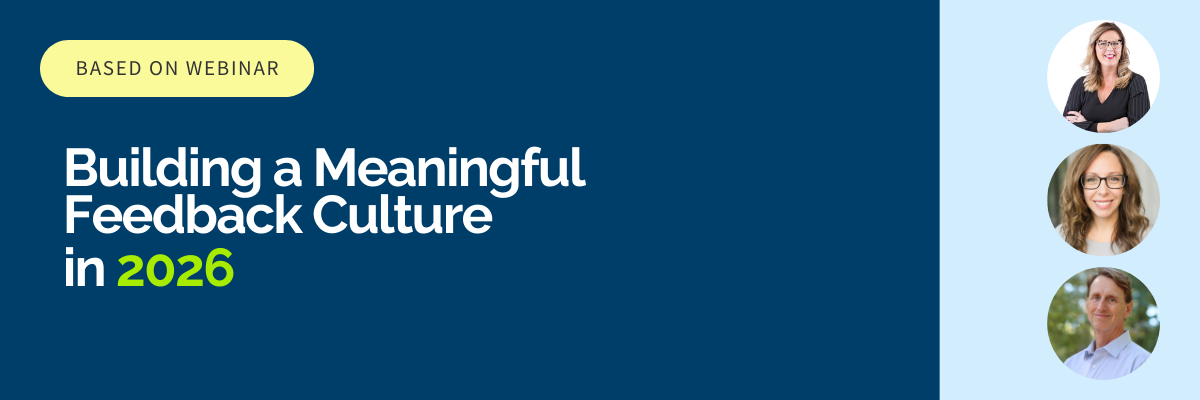
Learn effective feedback strategies for HR leaders. Discover how to create psychological safety, build employee development practices, and foster a meaningful feedback culture in 2026.
Feedback drives employee growth and organizational agility, but it’s often underutilized or ineffective. With teams being reorganized and employees feeling stuck in “job hugging,” creating a culture where feedback drives real development has never been more critical.
In a recent webinar, Keystone Partners brought together Brenda Stanton, moderator, Victoria Rayel, VP & Senior Career Management Consultant, and Tony Gambill, Executive Coach, to explore what makes feedback cultures thrive in 2026.
What HR Leaders Really Think About Feedback
When webinar participants were asked what comes to mind when they hear the word “feedback,” the responses painted a revealing picture of the complexity surrounding this topic:
Most popular response: Support (27% of responses)
Also prominent: Gift (13% of responses)
Other responses included: Growth (10%), criticism (10%), improvement (7%), along with care, coaching, constructive, empathy, direct caring, helping me grow, innovation, and even worry and negative.
This wide range (from “gift” and “support” to “worry” and “criticism”) reveals a fundamental truth: feedback means vastly different things to different people, and that’s exactly why building an effective feedback culture requires intentional strategy rather than a one-size-fits-all approach.
What’s Changed (and What Hasn’t) in Feedback Culture
The Constants: Psychological Safety Remains Foundational
Despite evolving workplace dynamics, psychological safety remains critical. Gambill noted that psychological safety “has become a term that has been used a lot more in the last 3 to 4 years” and emphasized that it means creating environments where “people have an opportunity to feel safe in sharing their opinions and perspectives, and feel valued in that.”
Without psychological safety, feedback efforts fall flat. Leaders need to understand how difficult it is for people to give upward feedback and “create avenues, and create openings, and create safety for them to be able to do so,” Gambill explained, “because it’s only serving us to have the data that we need to be able to make the better decisions for the greater good.”
What’s Evolved: From Annual Reviews to Continuous Conversations
The traditional annual performance review model has shifted. Gambill noted that “in the last 5 to 7 years, check-ins have become an ongoing, regular, common thing that people have heard about, that, hey, let’s have check-ins between the performance review, let’s have quarterly check-ins.”
Organizations are moving toward more frequent feedback exchanges integrated into regular conversations, reflecting the reality that employees need ongoing development support rather than just annual assessments.
Why Feedback Is So Difficult (and What Makes It Effective)
The Threat Response
One of the biggest barriers to effective feedback? Our brains are wired to perceive it as threatening. Gambill explained that “that threat, our amygdala, it treats it just as a physical threat, where we want to fight, flight, or freeze.”
This neurological reality affects both the giver and receiver of feedback. “It is hard on both ends,” Gambill noted. “It’s hard on the person giving feedback” as well as the person receiving it. Understanding this helps HR leaders recognize that resistance to feedback isn’t about being difficult – it’s about how our brains respond to perceived threat.
The Solution: Seeking Over Giving
A powerful shift in feedback culture involves teaching employees to actively seek feedback rather than waiting to receive it. As Gambill noted, ensuring that “people were actively seeking feedback, and regularly knew how to do that” is “as important as people knowing how to give feedback.” He emphasized that “that is the only thing that lessens threat.”
When employees ask for feedback, they control the process, which reduces the brain’s threat response and allows learning to occur more effectively.
Practical Strategies to Build Feedback Into Your Culture
1. Train Feedback as a Skill
Feedback isn’t intuitive, it’s a learned competency. The panelists emphasized that organizations benefit from treating feedback as a trainable skill, providing resources, workshops, and ongoing coaching for both giving and receiving feedback.
2. Make It Everyone’s Responsibility
Effective feedback cultures don’t rely solely on managers to initiate conversations. Creating an expectation that everyone, at all levels, should actively ask for and provide feedback transforms the dynamic and reduces the power imbalance that often makes feedback feel threatening.
3. Separate Development from Performance
One critical distinction that emerged: development conversations and performance evaluations serve different purposes and shouldn’t be conflated.
Rayel explained: “From a performance perspective, this is a job. Performance matters. We’re not here to just support each other. We do need to work too, and it’s okay. So that balance is important, and just being upfront about that.”
Creating space for pure development conversations, without the weight of performance consequences, allows employees to be more open about growth areas.
4. Leverage AI Thoughtfully
AI tools are increasingly being explored in feedback processes. Rayel emphasized that “this is paramount. This is a human experience. Full stop. But AI can be helpful.”
She outlined several potential applications: AI could help make feedback conversations “less biased, or see things from a more holistic perspective,” help automate frequent check-ins, assist employees in preparing talking points and articulating accomplishments, and help managers who “are not great coaches” with “framing questions and expanding conversations, and reframing things.”
However, the human element remains central. As Rayel made clear, feedback is fundamentally “a human experience,” with AI serving as a supportive tool rather than a replacement for genuine connection.
5. Build Trust Before Building Feedback Processes
Perhaps the most important insight from the discussion: “The feedback conversation is not going to go better or worse than the relationship that you built with that individual,” Gambill noted. “It’s the old saying: people don’t care what you know until they know that you care.”
No amount of training or sophisticated processes can compensate for lack of trust. Leaders must invest time and energy in relationships before feedback will land effectively.
One Thing to Implement Immediately
When asked for the single most important first step to build a meaningful feedback culture, Gambill emphasized ensuring that “people were actively seeking feedback, and regularly knew how to do that.”
Teaching employees how to actively seek feedback, rather than waiting to receive it, can transform your feedback culture. This simple shift from passive recipients to active seekers reduces the threat response and creates a foundation for meaningful development conversations.
The Bottom Line
Building a meaningful feedback culture in 2026 requires more than implementing new tools or processes. It demands a fundamental commitment to psychological safety, continuous learning, and genuine care for employee development.
As organizations navigate ongoing change, reorganization, and evolving work models, the ability to have honest, growth-oriented feedback conversations becomes a competitive advantage. Employees who receive regular, meaningful feedback learn faster, adapt more quickly, and contribute more effectively to organizational success.
The question isn’t whether your organization should prioritize feedback culture: it’s whether you can afford not to.
Ready to Build a Stronger Feedback Culture?
Creating meaningful feedback practices that drive employee growth and organizational agility requires expertise and strategy. Keystone Partners specializes in leadership development, career management consulting, and organizational change, helping HR leaders build the capabilities their teams need to thrive.
Want to strengthen your organization’s feedback culture? Contact us today to start the conversation and learn how our executive coaching, leadership development programs, and career transition services can help you create a culture where feedback fuels growth, engagement, and performance.